Tuesday, August 31, 2010

Bobby Rydell - All The Hits (1962)

Bobby Rydell was born Robert Ridarelli in Philadelphia. It was his father who encouraged him to pursue a career in show business. At the age of four, Rydell would sit in front of the TV and impersonate such performers as Milton Berle, Louis Prima and Johnny Ray. He also admired drummer Gene Krupa and began playing the drums at the age of six. At the age of seven and with his father's encouragement, Rydell began performing in nightclubs in Philadelphia.

In 1950, Bobby Rydell entered the amateur show of Paul Whiteman; his first-place win gained him a regular part on the show. He stayed with the Whiteman show for three years and then went to join several local bands in Philadelphia. It was here too that Bobby Ridarelli became the easier-to-pronounce Bobby Rydell. At 16 he began playing with local groups, landing a spot as a drummer for Rocco and the Saints. (Frankie Avalon, another Philadelphia-born musician, played trumpet for the group.) While with the band, Rydell signed a recording contract with Cameo/Parkway Records in Philadelphia. His hit "Kissin' Time," recorded in the summer of 1959, launched his musical career and made him a teen idol at the age of 17. Read on +/-

After making his first hit recording, he pursued a solo career, performing at the Copacabana in New York in 1961, where he was an instant hit. Rydell made his acting debut in 1962 on the television show Combat! One year later, he starred as Hugh Peabody in the famous musical Bye Bye Birdie. It was only after his acting debut that he fervently began playing the nightclub circuit. With records like "We Got Love," "Wildwood Days" and "Sway," Rydell made himself a hit. Along with Frankie Avalon and Fabian, Bobby Rydell is known as a Philadelphia-born teen idol, known not only for his musical genius but also his handsome looks.

Like many other stars at the time -- see a previous post of Bobby Vee -- Rydell recorded a lot of songs from other singers, that were hits at the time. In 1962 Cameo/Parkway released a series records with their most popular recording stars like: Chubby Checker; The Orlons; Dee Dee Sharp etc. The Series got the title "All The Hits" and consisted many of those hit covers. So here two "All The Hits" albums from Bobby Rydell -- still only vinyl, cause they never made it to CD.

1962 LP All The Hits (Cameo C-1019)


01. Bobby Rydell - Twistin' The Night Away
02. Bobby Rydell - Break It To Me Gently
03. Bobby Rydell - Dream Baby
04. Bobby Rydell - What's Your Name
05. Bobby Rydell - The One Who Really Loves You
06. Bobby Rydell - I've Got Bonnie
07. Bobby Rydell - I'll Never Dance Again
08. Bobby Rydell - I Know
09. Bobby Rydell - Don't Break The Heart That Loves You
10. Bobby Rydell - Baby It's You
11. Bobby Rydell - Soldier Boy
12. Bobby Rydell - Hey Baby

If you want to listen to the music... Look up in the right column.
Als je naar de muziek wilt luisteren... Kijk boven in de rechter kolom.


1962 LP All The Hits Volume 2 (US Cameo C 1040)


01. Bobby Rydell - Bobby's Girl
02. Bobby Rydell - Tell Him
03. Bobby Rydell - Ruby Ann
04. Bobby Rydell - Up On The Roof
05. Bobby Rydell - Im Gonna Be Warm This Winter
06. Bobby Rydell - Remember Then
07. Bobby Rydell - Telestar
08. Bobby Rydell - Loop De Loop
09. Bobby Rydell - The Alley Cat Song
10. Bobby Rydell - See See Rider
11. Bobby Rydell - Everybody Loves A Lover
12. Bobby Rydell - Two Lovers

If you want to listen to the music... Look up in the right column.
Als je naar de muziek wilt luisteren... Kijk boven in de rechter kolom.

Sunday, August 29, 2010

The Four Lovers - Joyride (1955)

The Four Seasons are justifiably among the most fondly remembered pop/rock vocal groups of the early to mid-'60s. Their soaring harmonies, coupled with Frankie Valli's exquisite falsetto lead on romantic, teenage-oriented songs, were as central to the early-'60s music scene as the work of the Beach Boys, Del Shannon, or any other top rock & roll names one cares to invoke from that period. But before Valli and company emerged with their first hit in the summer of 1962, they spent eight years working in music, first as the Variatones and, more permanently, as the Four Lovers. They never charted a record higher than number 62 (their only chart entry), but did record more than two dozen songs, including a complete LP for a major label. And their music roots were closer to Frank Sinatra than to Elvis Presley.

The Four Lovers started out in the early '50s, but the individual members' musical backgrounds went back to the 1930s. Their whole story started with the DeVito family of Belleville, a working-class town in northern New Jersey just outside of Newark, part of the same locale that produced Frank Sinatra, Connie Francis, and Lou Costello, among other performing legends during the 1930s. The whole family was musical and, beginning with eldest son Danny, took up singing and an instrument from their father. Tommy DeVito (born June 19, 1928) emerged in music at the age of ten, appearing on Major Bowes' Original Amateur Hour.
Read on +/-

Two years later, he was singing and playing guitar with Nickie & the Starliters, an octet modeled after the professional pop (or "sweet," as they were called) bands of the era, led by his older brother Nickie DeVito (born September 12, 1924), who also played bass. They made a decent part-time living, picking up extra cash playing dances, weddings, and parties until World War II and the draft broke up their membership. After World War II, the two DeVito brothers tried keeping their hands in music and hooked up with Nick Macioci (born September 19, 1927, and better-known in later years as Nick Massi) to form what became the Variety Trio. They played local clubs, all of them singing, with Tommy and Nickie DeVito on lead and rhythm guitar, respectively, and Massi playing the upright bass. After a couple of years of successful local gigs, they added a fourth, part-time member who began showing up at their performances, Frank Castelluccio (born May 3, 1934, and later known as Frankie Valli). He was 16, had a distinctive voice, and a repertory of two songs, "I Can't Give You Anything but Love" and "My Mother's Eyes."

The sight of the slightly built teenager with the falsetto voice doing those pre-war songs was a novelty in itself, and they went over well with the group's audience. The trio split up in 1952, and for a time during the next couple of years, Castelluccio and Tommy DeVito worked together in various backing bands and recorded a pair of songs together under the auspices of Corona Records in New York. They formed a new group, the Variatones, with Hank Majewski on rhythm guitar and Billy Thompson on drums, while "Frankie Valley," as he was calling himself by then, handled the bass.

In early 1956, they got an audition for RCA Victor, where they impressed the executives present with their harmony singing and their mixed repertory of country music and R&B. This wasn't an uncommon mix at the time, nor was it unheard of for white vocal groups who were the least bit adventurous. A few white outfits, such as the Crew-Cuts, became notorious in purist circles for making more commercially successful covers of R&B singles by black groups, but many did take up the music with only the most honest and honorable intentions -- because they liked it -- and one outfit from Texas, the Mints, was regarded at the time as a serious white equivalent to the Treniers. The Variatones liked the music and had the talent and years of experience, together and collectively.

The group got a contract and a new name, the Four Lovers, and began a year-long stay with the record label. Thompson was soon gone from the lineup, with Valley moved over to drums and Nickie DeVito back in the fold on bass. They made their recording debut with a decided R&B emphasis, including a pair of Otis Blackwell songs, "You're the Apple of My Eye" and "Diddilly Diddilly Babe," "Honey Love" from the Drifters, a cover of Faye Adams' "Shake a Hand," and "Please Don't Leave Me," written by Fats Domino. There were rocking sides there, though not even necessarily the kind of harmony based music that could be described as doo wop.

Their version of "Shake a Hand" was as much a showcase for Tommy DeVito's hot guitar playing as it was for the group's backup singing, and the lead vocal is closer to Elvis Presley than to the falsetto singing that Valli would succeed with fronting the group six years later. Blackwell's "You're the Apple of My Eye," which had such a mannered and exaggerated performance that it almost sounded like a parody of R&B harmony material, ended up as the Four Lovers' one and only chart entry, peaking at number 62. The group kept trying and RCA kept trying with them, releasing another single and then an entire LP, entitled Joyride.

The latter is interesting to hear, both as a cultural artifact for the variety of vocal material (which includes a rocked up version of Irving Berlin's "White Christmas" and a cover of Lloyd Price's "Lawdy Miss Clawdy," and also pop numbers, a concession to the fact that early rock & roll listeners didn't buy many LPs) and as a document of the group's range, stuck in among the vocal numbers is the title track, an instrumental which was a surprise coming from a group known for its singing. By that time, rock & roll was sweeping the charts and the group's act was appropriately oriented toward harmony versions of R&B material. It wasn't enough to sell them to the public and in early 1957, they were dropped by RCA Victor.

The Four Lovers came to an end as a name but not a group during the next few years. They did a lot of backup singing on behalf of other artists in sessions run by Crewe, and occasionally cut records of their own for local labels under various names until they finally settled on the Four Seasons in 1961. Their lineup, by then, was Frankie Valli, Bob Gaudio, Tommy DeVito, and Nick Massi. The group wasn't working nearly full-time or making much money, however, and by 1962, Valli was making his living in construction. It was in the spring of that year that Bob Gaudio came up with a song called "Sherry," that he insisted by given to Valli and their group to cut. Crewe agreed and released by the Vee-Jay label, it hit number one nationally barely a month after release, thus beginning a new, more visible and successful phase in the history of the Four Seasons.

1955 LP Joyride (US RCA Victor LPM-1317)


01. The Four Lovers - I Want A Girl (Just Like The Girl That Married Dear Old Dad)
02. The Four Lovers - Such A Night
03. The Four Lovers - (I Love You) For Sentimental Reasons
04. The Four Lovers - Joyride
05. The Four Lovers - This Is My Song
06. The Four Lovers - Memories Of You
07. The Four Lovers - It's To Soon To Know
08. The Four Lovers - San Antonio Rose
09. The Four Lovers - White Christmas
10. The Four Lovers - Night Train
11. The Four Lovers - Cimarron
12. The Four Lovers - Lawdy Miss Clawdy

If you want to listen to the music... Look up in the right column.
Als je naar de muziek wilt luisteren... Kijk boven in de rechter kolom.

The Castells - So This Is Love (1962)

The Castells were a male vocal quartet from Santa Rosa, California best remembered for their hits "Sacred" (#20 in 1961) and "So This Is Love" (#21 in 1962). The group originally started with three members in November of 1958. In February 1959 Bob Ussery was added to the group, and that summer joined Joe Kelly after one of the early singers left. Only Tom Hicks and Chuck Girard stayed as first members of the group.

Their sound blended light rock with elements of collegiate harmony singing and jazz, and proved popular with teenagers as well as adults. The Castells was formed at Santa Rosa, CA High School, circa 1959. They were booked for a performance at a local teenage "canteen". They did not have a name, and their pianist, Jeff Bush, suggested the name. It had no meaning other than they thought that it sounded good, and the intent was to be more thoughtful and change it later. They obviously never did. Through a local Santa Rosa KJAX disc-jockey who went by the name of Dan Dillon, they got some Hollywood contacts. Girard's mother financed a demo for $100., which was recorded in a San Francisco studio. Read on +/-

They took their demo and went door-to-door in Hollywood, first to Crystalette Records,which seemed to be defunct, Alladin records, and then Era Records. They were excited that Alladin seemed interested, as they considered themselves to be R&B, but eventually it was Era who signed them with some help of Dillon. Their first release "Little Sad Eyes", went to "Bubbling Under" on the Billboard chart, then came "Sacred", which charted for them. The next,"Make Believe Wedding," went again "Bubbling Under", but then "So This Is Love" again charted.

The Castells played shows for a few years, and were privileged to share the stage with many of their idols, among them Jackie Wilson, Jerry Lee Lewis, Bobby Vee, and Brenda Lee. They never again charted, but did continue to record for a few years, first for Warner Brothers Records, and then lastly, Decca Records. They disbanded around 1964.

1962 LP So This Is Love (US Era ES-109)


01. The Castells - So This Is Love
02. The Castells - I Get Dreamy
03. The Castells - Some Enchanted Evening
04. The Castells - The Vision Of You
05. The Castells - Stiki De Boom Boom
06. The Castells - Make Believe Wedding
07. The Castells - Oh! What It Seemed To Be
08. The Castells - Sacred
09. The Castells - Stand There Mountain
10. The Castells - Little Sad Eyes
11. The Castells - Clown Prince
12. The Castells - Dancing In The Dark

If you want to listen to the music... Look up in the right column.
Als je naar de muziek wilt luisteren... Kijk boven in de rechter kolom.

Tuesday, August 24, 2010

The Cleftones - Doo-Wop in Hart And Soul (1961)

Formed in Queens, NY, in 1955, the Cleftones consisted of five friends from Jamaica High School -- Herb Cox (lead), Warren Corbin (bass), Charlie James (first tenor), William McClain (baritone), and Berman Patterson (second tenor). Originally signed to Gee, the group released its first single, "You Baby You," late in 1955; an up-tempo doo wop song, the record became a regional hit. "Little Girl of Mine," the Cleftones' second single, broke nationally, charting at number eight R&B and number 57 pop in 1956; two other similar singles, "Can't We Be Sweethearts" and "String Around My Heart," were released the same year, yet they failed to attract national attention. "See You Next Year," a ballad the group recorded in 1957, did not earn the group an audience outside of New York. Two years later, McClain left the group and was replaced by Gene Pearson from the Rivileers. Patricia Spann was also added to the Cleftones' lineup that year, which helped nudge the band away from traditional group-oriented doo wop harmonies and toward a vocal sound that was dominated by the lead vocals. In 1961, the Cleftones realized the potential of the sound with their smash hit version of the standard "Heart and Soul"; it became the group's biggest hit, reaching number 18 on both pop and R&B charts. Later that year, the group had another hit with "For Sentimental Reasons," but the band had reached a peak with "Heart and Soul" and were never able to reach those heights again. The Cleftones broke up in 1964, three years after their greatest success.

1961 LP Heart And Soul (US Gee SGLP-705)

01. The Cleftones - Heart And Soul
02. The Cleftones - How Do You Feel
03. The Cleftones - A Hunderd Pounds Of Clay
04. The Cleftones - Please Say You Want Me
05. The Cleftones - Can't We Be Sweethearts
06. The Cleftones - Time Is Running Out On Our Love
07. The Cleftones - Little Girl Of Mine
08. The Cleftones - Heavenly Father
09. The Cleftones - Glory Of Love
10. The Cleftones - You And I Can Climb
11. The Cleftones - You Baby You
12. The Cleftones - String Around My Heart

If you want to listen to the music... Look up in the right column.
Als je naar de muziek wilt luisteren... Kijk boven in de rechter kolom.


1961 LP For Sentimental Reasons (US Gee GLP-707)


01. The Cleftones - For Sentimental Reasons.mp3
02. The Cleftones - Blues In The Night
03. The Cleftones - Red Sails In The Sunset
04. The Cleftones - She's Gone
05. The Cleftones - Vacation In The Mountains
06. The Cleftones - My Babe She's A Rolling Stone
07. The Cleftones - Earth Angel
08. The Cleftones - Deed I Do
09. The Cleftones - Shadows On The Very Last Row
10. The Cleftones - What Did I Do That Was Wrong
11. The Cleftones - Hey Babe
12. The Cleftones - Leave My Woman Alone

If you want to listen to the music... Look up in the right column.
Als je naar de muziek wilt luisteren... Kijk boven in de rechter kolom.

Monday, August 23, 2010

The Lively Ones are Surfin' again

One of the best of the many instrumental surf bands working the Southern California region in 1963, the Lively Ones made recordings built around storming, reverb-drenched Fender guitars embellished by occasional raunchy sax breaks. Originality was not the Lively Ones' forte; over a period of about 12 months, they ground out about five albums, filled out with many covers or retitled numbers based on other rock and R&B compositions. They had a couple of hits in the L.A. area in 1963 ("Surf Rider" and "Rik-A-Tik"), but their best moment was probably "Goofy Foot," whose staccato gunfire of riffs deservedly propelled the track onto several modern best-of-surf anthologies. They ranged far and wide for source material, giving the surf treatment to "Telstar," "Exodus," "Rawhide," and Cole Porter's "Night and Day." Even the overdone standards are arranged and executed with panache. One best-of compilation is all you need, but anyone who likes Dick Dale will dig the Lively Ones' similar sleek arrangements and prototypically twangy, classy surf guitar leads.

1963 LP Surf Rider (US Del-Fi DFLP-1226)

By the time their debut LP, Surf Rider! made it to store shelves in 1963, they had already issued a handful of singles, the most successful being a reworking of the Ventures' deep LP cut "Spudnik," rechristened as "Surf Rider." Although it made little impact nationally, the catchy tune and beguiling beat became a local smash, prompting Del-Fi to compile an album's worth of material with previously available sides, a few new originals, as well as some songs that would have been familiar to the audience. During an era marked by a plethora of nominally talented and ersatz sound-alike cover bands, in retrospect the Lively Ones' music remains noteworthy for their strong self-penned numbers. Among those highlights are the bouncy mid-tempo "Happy Gremmie," the driving rhythm behind "Walkin' the Board," and above all the gritty "Goofy Foot." As was customary, they also retooled and personalized concurrently popular melodies, including obligatory interpretations of Dick Dale's "Misirlou," "Let's Go Trippin'," and the solid opener "Surf Beat." Buoyed by incisive interplay between Masoner and Willenbring, other standouts are "Guitar Man" -- a Top 20 hit for Duane Eddy -- and the darkly brooding "Caterpillar Crawl."

01. The Lively Ones - Surf Beat
02. The Lively Ones - Let's Go Trippin'
03. The Lively Ones - Misirlou
04. The Lively Ones - (Dance With The) Guitar Man
05. The Lively Ones - The Caterpillar Crawl
06. The Lively Ones - Walkin' The Board
07. The Lively Ones - Paradise Cove
08. The Lively Ones - Goofy Foot
09. The Lively Ones - Surf Rider
10. The Lively Ones - Happy Gremmie
11. The Lively Ones - Hotdoggen
12. The Lively Ones - Surfer's Lament

If you want to listen to the music... Look up in the right column.
Als je naar de muziek wilt luisteren... Kijk boven in de rechter kolom.

1963 LP Surf Drums (US Del-Fi DFLP-1231)


The second Lively Ones long-player, Surf Drums (1963), was compiled in much the same way their debut had been created, comparable to the vast majority of rush-released platters of the era. Del-Fi Records owner Bob Keane collected a few of the band's previous singles alongside a variety of already established covers, many of which were concurrent hits for other artists. The instrumental quintet had gained a sizable name for themselves in and around the Orange County, CA, scene, scoring regionally on covers of the Ventures' dynamic "Spudnik" and the Fireballs' effervescent "Rik-A-Tic." The album opens up with a remake of Duane Eddy's mid-tempo, ambling "40 Miles Bad Road." The track is the perfect vehicle for Jim Masoner (guitar) and Joel Willenbring (sax), whose collaborations became an integral ingredient not only in the Lively Ones' sound, but helped to separate them from the plethora of similar units. Providing support for the soloists and rounding out the personnel are solid contributions from Ed Chiaverini (guitar), Ron Griffith (bass), and Tim Fitzpatrick (drums). Despite the dearth of original compositions, the aggregate muscle through some choice overhauls of genre favorites, most notably the soulful strut of the Rockin' Rebels' "Wild Weekend," the high-energy yakety sax on the Belairs' "Mr. Moto" and the analogous rearrangement of "Tuff Surf," an R&B entry from the relatively obscure Nobel Watts.

01. The Lively Ones - Surf Beat
02. The Lively Ones - Let's Go Trippin'
03. The Lively Ones - Misirlou
04. The Lively Ones - (Dance With The) Guitar Man
05. The Lively Ones - The Caterpillar Crawl
06. The Lively Ones - Walkin' The Board
07. The Lively Ones - Paradise Cove
08. The Lively Ones - Goofy Foot
09. The Lively Ones - Surf Rider
10. The Lively Ones - Happy Gremmie
11. The Lively Ones - Hotdoggen
12. The Lively Ones - Surfer's Lament

If you want to listen to the music... Look up in the right column.
Als je naar de muziek wilt luisteren... Kijk boven in de rechter kolom.


1963 LP Surf City (US Del-Fi DFLP-1237)


Following in much the same format as preceding releases, the platter consisted primarily of cuts that had been previously issued as singles or were initially left off previous LPs -- perhaps the most egregious example being "Surf Rider" (the title track from their 1963 debut album) -- in addition to a handful of "new" sides. As was fairly common practice at the time, there are several high-profile cover versions of well-established hits, which is how Surf City commences. The instrumental reworking of Jan & Dean's June 1963 chart-topper was undoubtedly a recent supplement to the Lively Ones' repertoire, as the original had only been around for a few months. Conversely, their carbon copy of Dick Dale's anthemic "Miserlou" -- another repeat from Surf Rider -- and the subdued interpretation of Santo & Johnny's "Sleepwalk" had already become surf rock staples. "Head's Up," a lesser-known entry from R&B guitarist Freddie King, is given a punchy reading that motors along with some tasty interplay between saxophonist Joel Willenbring and lead guitarist Jim Masoner. Speaking of King, they close with a spirited translation of his "Butterscotch," cleverly rechristened as "Forty Miles of Bad Surf." The languid and moody "Malibu Run" is one of two group-penned numbers, proving that while not as prolific as their record company might have desired, the Lively Ones easily made up for it with quality.

01. The Lively Ones - Surf City
02. The Lively Ones - Telstar Surf
03. The Lively Ones - Heads Up
04. The Lively Ones - Malibu Run
05. The Lively Ones - Miserlou
06. The Lively Ones - Surf Rider
07. The Lively Ones - Soul Surfer
08. The Lively Ones - Sleep Walk
09. The Lively Ones - Crazy Surf
10. The Lively Ones - Livin'
11. The Lively Ones - Tranquilizer
12. The Lively Ones - Forty Miles Of Bad Surf

If you want to listen to the music... Look up in the right column.
Als je naar de muziek wilt luisteren... Kijk boven in de rechter kolom.


1964 LP Surfin' South Of The Border (US Del-Fi DFLP-1240)


The dozen cuts on 1964's Surfin' South of the Border are split among the Lively Ones and the Surf Mariachis -- the latter consisting of five renowned West Coast studio session instrumentalists under the direction of Del-Fi Records owner Bob Keane. The results yielded what was arguably one of the first "concept albums" of the surf rock subgenre. The project was unabashedly designed as a vehicle to release the remnants of the the Lively Ones' previous endeavors. The remaining time was filled with new Latin-flavored versions of tunes already well known by the targeted teen audience. Regardless of how opportunistic those terms might seem, give credit where credit is due, as Keane pulls off yet another inspired collection. Truth be told, it is curious why Lively Ones tracks such as the spirited opener, "Torquay," and the echoplex-happy reading of Ernest Gold's 1960 Oscar-winning composition "Exodus" were initially left on the editing room floor. The personnel of the Surf Mariachis boasted Conte Candoli (trumpet), Tom Scott (sax), Jay Migliori (sax), Billy Strange (guitar), and Frankie Capp (percussion), so it isn't that difficult to understand why they sound comparatively polished. "Watermelon Man" is a particularly tasty groove, as is Lalo Schifrin's frenetic "Undertow" and Lee Hazlewood's "Baja Surf," all of which strike a perfect balance between cool and kitsch.

01. The Lively Ones - Torquay
02. The Surf Mariachis - Baja Surf
03. The Lively Ones - Mexico
04. The Surf Mariachis - Limbo Rock
05. The Surf Mariachis - More
06. The Lively Ones - Exodus
07. The Lively Ones - Tequila
08. The Surf Mariachis - Watermelon Man
09. The Surf Mariachis - Undertow
10. The Lively Ones - Walking Memories (aka Surfing Mem
11. The Lively Ones - Latinia
12. The Surf Mariachis - Surf Fiesta

If you want to listen to the music... Look up in the right column.
Als je naar de muziek wilt luisteren... Kijk boven in de rechter kolom.

Saturday, August 21, 2010

The Golden Earrings - The early years (1965-1967)

In 1961 four schoolboys, all from one neighborhood in The Hague, The Netherlands, started a band 'The Tornadoes.' The band consisted of young Rinus Gerritsen (bass), George Kooymans (guitar), Hans van Herwerden (guitar) and Fred van der Hilst (drums). In their early phase the Tornadoes played mostly covers of instrumentals of The Ventures and The Shadows like so many other bands in that period. When, in November 1962, the British Tornadoes scored a huge hit with "Telstar," their counterpart from The Hague realized that a new name must be invented. "Golden Earrings," a 1961 instrumental of the British guitar band 'The Hunters,' and also on the playlist of the boys, offers the solution. The band renamed itself to 'The Golden Earrings,' and first in the line of shuffling took place; Van Herwerden was replaced by Peter de Ronde (guitar).

In 1963 the first beat sounds blew over from England and brought the Golden Earrings to their senses that popularity of instrumentals was over. Beat vocals did take their place, and the recruitment of a singer was their most logical next step. Frans Krassenburg became that new vocalist. At the end of 1964 also Fred van der Hilst was leaving the Earrings and the band recruited the more talented Jaap Eggermont. In the meantime the band worked on its own repertoire, supplemented with covers of The Kinks and The Zombies. Read on +/-

1965 Turned out to be a crucial year in the existence of the Golden Earrings. During a gig in Scheveningen, the band was discovered by Fred Haayen, who at that time was still a student with a part-time job in the warehouse of Polydor records. But nevertheless he brought the young group to a recording contract. With the growing success of his discovery, also the star of Fred Haayen was rising. Later on he became director of Polydor and made career in America in the music industry. Haayen would produce the Golden Earring (without the 's' at that time) till the mid-70s, and was -- until a decade later -- business adviser to the group.

The year sixty five also saw their debut LP, "Just Earrings." A charming, but also not really perfect beat record. You still can hear how close the band was with their examples. The Golden Earrings played the classic rhythm & blues song "Sticks And Stones" note for note like The Zombies covered it a few months earlier -- including the excited cries. One of their own songs, "Please Go," showed up as the first single release. It ends on #10 of the Dutch 'Veronica hit list.' The release of the second single, "Lonely Every Day," was withdrawn the last minute, because they found out that the b-side, "Not To Find," had a grammatically incorrect title. You see... 'Yesterday's Gold' is not the only place with bad English. (Sorry!)

The year 1966 began with a ringing top three hit, "That Day." The first Dutch pop single recorded in England. The breakthrough of the Earrings was a fact. The band was the figurehead of an exploding The Hague beat scene, which yields groups as Q 65, Shocking Blue, The Motions and hundreds of lesser known bands. The Hague was for for several years the 'Liverpool of Holland'. The Golden Earrings scored several other hits with fresh beat songs as: "If You Leave Me;" "Daddy Buy Me A Girl;" and "Don't Run Too Far." Shortly before the release of their second album, "Winter Harvest," guitarist Peter de Ronde left the band.

Just after the release of Winter Harvest, in 1967, also Frans Krassenburg disappeared from the band, but one year later he would still live on old glory by his #20 hit single "Golden Earrings." Krassenburg was replaced by Barry Hay, from 'The Haigs.' Hay refuses an offer of 'Shocking Blue,' and saw the Golden Earrings as a better choice . "Sound Of The Screaming Day" was the first single release with him in the band, but Barry was heard only on flute. George Kooymans handled the vocals. It was a new big hit for the band. The year ended with "Together We Live, Together We Love." But after all, The Golden Earring stood just at the beginning of a long international career.

The Golden Earrings - The Early Singles 1965-1967


The Golden Earrings - Please Go / 1965 Polydor S1181
The Golden Earrings - Chunk Of Steel / 1965 Polydor S1181
The Golden Earrings - Lonely Everyday / 1965 Polydor S1185 (withdrawn)
The Golden Earrings - Not To Find / 1965 Polydor S1185 (withdrawn)
The Golden Earrings - That Day / 1966 Polydor 421.023
The Golden Earrings - The Words I Need / 1966 Polydor 421.023
The Golden Earrings - If You Leave Me / 1966 Polydor 421.036
The Golden Earrings - Waiting For You / 1966 Polydor 421.036
The Golden Earrings - Daddy Buy Me A Girl / 1966 Polydor 421.050
The Golden Earrings - What You Gonna Tell / 1966 Polydor 421.050
The Golden Earrings - Don't Run To Far / 1966 Polydor 421.056
The Golden Earrings - Wings / 1966 Polydor 421.056
The Golden Earrings - In My House 1967 Polydor / S1223
The Golden Earrings - Smoking Cigarettes 1967 Polydor / S1223
The Golden Earrings - Sound Of The Screaming Day / 1967 Polydor S1244
The Golden Earrings - She Won't Come To Me 1967 Polydor / S1244
The Golden Earrings - Together We Live, Together We Love / 1967 Polydor S1250
The Golden Earrings - I Wonder / 1967 Polydor S1250

If you want to listen to the music... Look up in the right column.
Als je naar de muziek wilt luisteren... Kijk boven in de rechter kolom.


1965 LP Just Earrings (NL Polydor 007)


01. The Golden Earrings - Nobody But You
02. The Golden Earrings - I Hate Saying These Words
03. The Golden Earrings - She May Be
04. The Golden Earrings - Holy Witness
05. The Golden Earrings - No Need To Worry
06. The Golden Earrings - Please Go
07. The Golden Earrings - Sticks And Stones
08. The Golden Earrings - I Am A Fool
09. The Golden Earrings - Don't Stay Away
10. The Golden Earrings - Lonely Everyday
11. The Golden Earrings - When People Talk
12. The Golden Earrings - Now I Have

If you want to listen to the music... Look up in the right column.
Als je naar de muziek wilt luisteren... Kijk boven in de rechter kolom.


1967 LP Winter Harvest (NL Polydor Special 736.068)


01. The Golden Earrings - Another Man In Town
02. The Golden Earrings - Smoking Cigarettes
03. The Golden Earrings - In My House
04. The Golden Earrings - Don't Wanna Loose That Girl
05. The Golden Earrings - Impeccable Girl
06. The Golden Earrings - Tears And Lies
07. The Golden Earrings - You've Got The Intention To Hurt Me
08. The Golden Earrings - Dream
09. The Golden Earrings - You Break My Heart
10. The Golden Earrings - Baby Don't Make Me Nervous
11. The Golden Earrings - Call Me
12. The Golden Earrings - Happy And Young Together
13. The Golden Earrings - Lionel The Miser
14. The Golden Earrings - There Will Be A Tomorrow

If you want to listen to the music... Look up in the right column.
Als je naar de muziek wilt luisteren... Kijk boven in de rechter kolom.

Thursday, August 19, 2010

Jimmy Gilmer and the Fireballs - Sugar Shack (1963)

On request, two nice 1963 albums from the Fireballs. The first one, 'Torquay,' was in line with several very good more early instrumental platters from the group. 'Sugar Shack' was titled to the first million seller for Gilmer, and credited as 'Jimmy Gilmer and the Fireballs.' The title song was written in 1962 by Keith McCormack and Faye Voss. Gilmer, then aged 23, came from Amarillo, Texas, and began singing as a youngster in La Grange, IIIinois. In 1951 he moved with his family to Amarillo where he studied the piano for four years at the Musical Arts Conservatory. In 1957, he organized his own rock 'n' roll band, playing for schools and other teenage functions. While attending Amarillo College (for an engineering degree), he continued to perform.

Jimmy Gilmer, born in Chicago, 1939, met the Fireballs (Stan Lark, Eric Budd and George Pomsco) at Norman Petty's recording studios in Clovis, New Mexico. The Fireballs had already some success on disc, and Jimmy teamed up with them as singer and rhythm guitarist. Their first hit was "Quite a Party" (#27 in 1961). Then came "Sugar Shack", and subsequent tours of Canada and Europe. The disc was #1 for five weeks in the U.S.A., with 15 weeks in Billboard hot 100; #45 in Britain and eight weeks in the bestsellers, and a top rhythm-and blues seller. It was also a huge hit in many other countries all over the world. The Fireballs, sans Gilmer, made one last unexpected comeback in 1968, when their "Bottle of Wine" (featuring vocals by the group themselves) made the Top Ten.

1963 LP Torquay (US Dot DLP-25512)

01. Fireballs - Torquay
02. Fireballs - Alone
03. Fireballs - Joey's Song
04. Fireballs - Last Date
05. Fireballs - Chief Whoopin`Koff
06. Fireballs - El Ringo
07. Fireballs - Wheels
08. Fireballs - Honey
09. Fireballs - Rawhide
10. Fireballs - Tuff-A-Nuff
11. Fireballs - Dumbo
12. Fireballs - Quite A Party

If you want to listen to the music... Look up in the right column.
Als je naar de muziek wilt luisteren... Kijk boven in de rechter kolom.


1963 LP Sugar Shack (US DOT DLP-25545)


01. Jimmy Gilmer & The Fireballs - Sugar Shack
02. Jimmy Gilmer & The Fireballs - Let's Talk
03. Jimmy Gilmer & The Fireballs - Linda Lu
04. Jimmy Gilmer & The Fireballs - Lonesome Tears
05. Jimmy Gilmer & The Fireballs - Let The Good Times Roll
06. Jimmy Gilmer & The Fireballs - Red Cadillac And A Black Mustache
07. Jimmy Gilmer & The Fireballs - Won't Be Long
08. Jimmy Gilmer & The Fireballs - Little Baby
09. Jimmy Gilmer & The Fireballs - I Wonder Why
10. Jimmy Gilmer & The Fireballs - Suzie Q
11. Jimmy Gilmer & The Fireballs - Pretend
12. Jimmy Gilmer & The Fireballs - Almost Eighteen

If you want to listen to the music... Look up in the right column.
Als je naar de muziek wilt luisteren... Kijk boven in de rechter kolom.

Wednesday, August 18, 2010

Marv Johnson - Marvelous And More (1960)

Best remembered for a handful of hits including the Top Ten smashes "You Got What It Takes" and "I Love the Way You Love," Marv Johnson was also a seminal figure in the early history of Motown Records. Marvin Earl Johnson was born in Detroit, MI in 1938, and was raised in a musical environment that mixed the gospel music of the Baptist church with the jump-jazz of Louis Jordan and his Tympany Five. By the time he was in high school he had joined a local singing group, playing carnivals and fairs. In 1958, he cut his first sides, "My Baby-O" and "Once Upon a Time;" the single failed to sell, but the recording session resulted in a meeting with songwriter and would-be record producer Berry Gordy. Read on +/-

After Johnson played his original song "Come to Me" for Gordy and his future wife Raynoma, the couple chose Johnson as the first artist for their fledgling record label, Tamla. Because the new label didn't have distribution outside of Detroit, "Come to Me" (credited to Gordy and Johnson) was released nationally by United Artists, and rose to No. 6 on the R&B charts and No. 30 on the pop charts. Gordy soon lost direct control of his first discovery after United Artists signed Johnson directly, but continued as the singer's manager. Johnson also toured with Motown acts such as the Miracles in addition to appearing on Alan Freed's rock & roll revues and media venues such as American Bandstand, and joined early package tours and stage revues where he shared bills with his idols Sam Cooke and Jackie Wilson.

Johnson's second single fared poorly, but his third, 1959's "You've Got What It Takes," exploded onto the charts, becoming a Top Ten hit and earning a gold record. The 1960 follow-up "I Love the Way You Love" also landed in the Top Ten; among his subsequent singles, "You've Got to Move Two Mountains" was a more pop-flavored effort that reached the Top 20, while "Happy Days" got to number seven on the R&B charts late in 1960. "Merry-Go-Round," issued in early 1961, was Johnson's last chart success. Even many R&B and soul fans have overlooked the greatness of Marv Johnson, whose smooth, exuberant, and sometimes poignant style helped turn some weepy numbers into triumphant outings. He sounded uniformly great throughout this early '60s albums, doing everything from light pop to anguished soul and singing with strength, conviction, and intensity.

1960 LP Marvelous Marv Johnson (US United Artists UAL 3081)


01. Marv Johnson - September In The Rain
02. Marv Johnson - You've Got What It Takes
03. Marv Johnson - Summertime
04. Marv Johnson - 's Wonderful
05. Marv Johnson - I Can't Get Started
06. Marv Johnson - Come To Me
07. Marv Johnson - Let Me Love You
08. Marv Johnson - Almost Like Being In Love
09. Marv Johnson - Love Is Here To Stay
10. Marv Johnson - I'm Coming Home
11. Marv Johnson - When I Fall In Love
12. Marv Johnson - Don't Leave Me


1960 LP More Marv Johnson (US United Artists UAL-3118)


01. Marv Johnson - Baby, Baby.mp3
02. Marv Johnson - This Heart Of Mine (Will Surely Sing)
03. Marv Johnson - I Love The Way You Love Me
04. Marv Johnson - River Of Tears
05. Marv Johnson - Clap Your Hands
06. Marv Johnson - Ain't Gonna Be That Way
07. Marv Johnson - When You've Lost Your Love
08. Marv Johnson - I Need You
09. Marv Johnson - Easier Said (Than Done)
10. Marv Johnson - Let Me Love You
11. Marv Johnson - What A Need
12. Marv Johnson - All The Love I've Got

If you want to listen to the music... Look up in the right column.
Als je naar de muziek wilt luisteren... Kijk boven in de rechter kolom.

Tuesday, August 17, 2010

Manfred Mann - The Manfred Mann Album (1964)

Manfred Mann's debut full-length U.S. platter was probably their strongest, and indeed one of the stronger British Invasion albums of the very competitive year of 1964. Besides the smash "Do Wah Diddy Diddy," it contained a number of fine soul and R&B covers. Standouts were the versions of "Untie Me" and Ike & Tina Turner's "It's Gonna Work Out Fine," as well as the strong pounding Paul Jones original, "Without You."

1964 LP The Manfred Mann Album (US Ascot AM(S)-13015)

01. Manfred Mann - Do Wah Diddy Diddy
02. Manfred Mann - Don't Ask Me What I Say
03. Manfred Mann - Sack O'woe
04. Manfred Mann - What You Gonna Do
05. Manfred Mann - I'm Your Hoochie Coochie Man
06. Manfred Mann - Smokestack Lightning
07. Manfred Mann - Got My Mojo Working
08. Manfred Mann - It's Gonna Work Out Fine
09. Manfred Mann - Down The Road Apiece
10. Manfred Mann - Untie Me
11. Manfred Mann - Bring It To Jerome
12. Manfred Mann - Without You

If you want to listen to the music... Look up in the right column.
Als je naar de muziek wilt luisteren... Kijk boven in de rechter kolom.

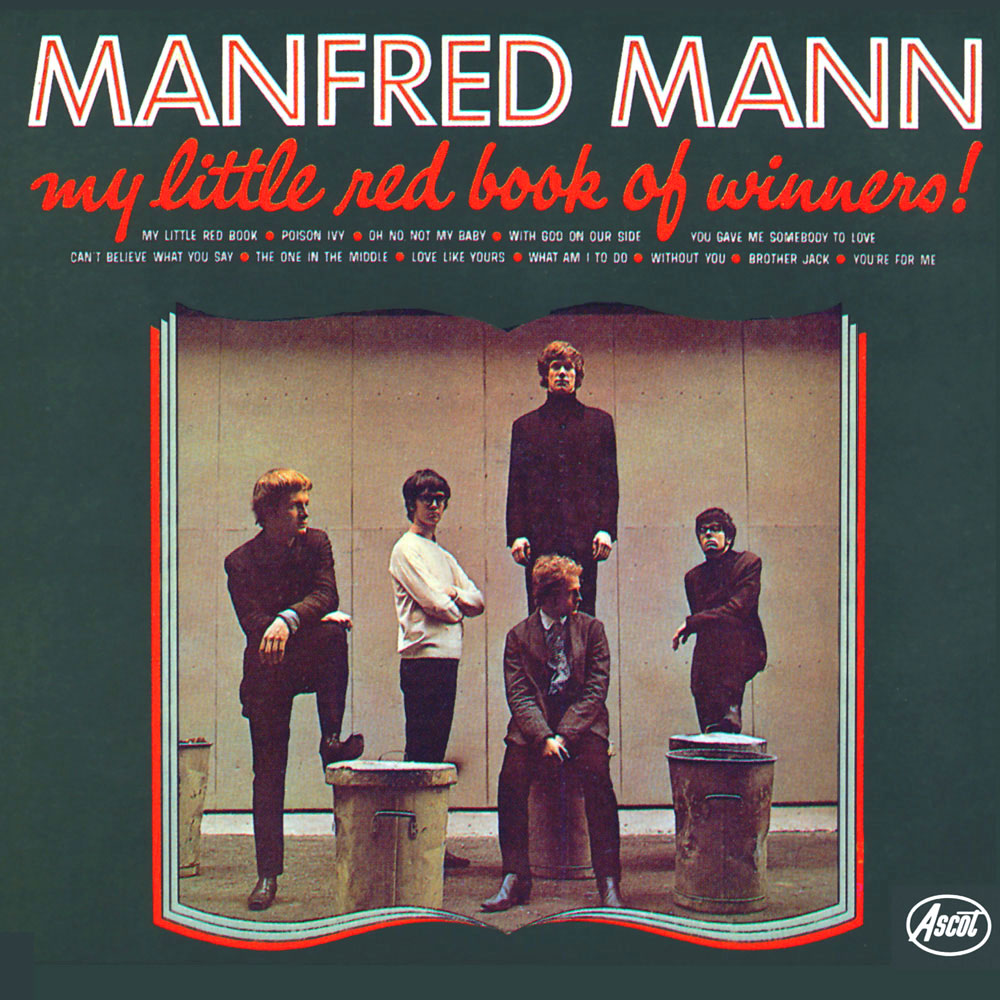
One of Manfred Mann's finest early records, My Little Red Book of Winners was, aside from being a fine album that captured the band's early sensibility, a highly influential record. The hit song "My Little Red Book," an excellent arrangement of the Bacharach/David masterpiece, was included in the hit movie What's New Pussycat. It was there that Love's lead singer Arthur Lee first heard it, after which he arranged it for his band. Lee also aped a sense of style and phrasing from Mann's lead singer, Paul Jones, and did so to great effect. The rest of this record is equally brilliant in spots. "The One in the Middle," an excellent midtempo blues from Jones, proved what a fine and witty songwriter he was. Other covers on the album include "Oh No, Not My Baby" and "With God on Our Side," which illustrate how effectively the band could capture any style and make it their own.

1965 LP My Little Red Book Of Winners! (US Ascot ALM(S)-13021)

01. Manfred Mann - My Little Red Book
02. Manfred Mann - Oh, No, Not My Baby
03. Manfred Mann - What Am I To Do
04. Manfred Mann - The One In The Middle
05. Manfred Mann - You Gave Me Somebody To Love
06. Manfred Mann - You're For Me
07. Manfred Mann - Poison Ivy
08. Manfred Mann - Without You
09. Manfred Mann - Brother Jack (Frére Jacques)
10. Manfred Mann - A Love Like Yours (Don't Come Knocking Everyday)
11. Manfred Mann - I Can't Believe What You Say
12. Manfred Mann - With God On Our Side

If you want to listen to the music... Look up in the right column.
Als je naar de muziek wilt luisteren... Kijk boven in de rechter kolom.

Monday, August 16, 2010

Jimmy Jones - Good Timin' (1961)

Best known for his 1960 R&B smash "Handy Man," Jimmy Jones sang in a smooth yet soulful falsetto modeled on the likes of Clyde McPhatter and Sam Cooke. Born in Birmingham, AL, Jones moved to New York with his family and began his entertainment career as a tap dancer. In 1954, he joined his first doo wop group, the Berliners, who soon changed their name to the Sparks of Rhythm. Jones recorded a few sides with them in 1955, then left to form his own group, the Savoys. They recorded for Savoy in 1956, then jumped to Rama and changed their name to the Pretenders (after the Platters song). The Pretenders cut sides for several labels over the next few years, a few under the name the Jones Boys, before disbanding in 1959. Tired of serving as a group leader, Jones embarked on a solo career with the MGM-owned Cub label later that year. Read on +/-

Teamed with writer/producer Otis Blackwell, Jones recorded a song he'd written back in his Sparks of Rhythm days called "Handy Man." By early 1960, "Handy Man" had rocketed into the Top Five on both the pop and R&B charts. Jones followed "Handy Man" with another Top Ten hit, "Good Timin'," later that year. That proved to be the full extent of his major commercial success, although he kept recording through most of the '60s. He remained with Cub until 1962, scraping the lower reaches of the charts with "That's When I Cried" and "I Told You So." He recorded for Ro-Jac and Vee Jay over the next two years, and his work gradually took on a New York-style uptown soul flavor. From 1965-1967, he cut sides for Roulette, Parkway, and Bell, none of which restored his commercial standing despite some fine performances.

1961 LP Good Timin' (US MGM S-3847)


01. Jimmy Jones - Good Timin'.mp3
02. Jimmy Jones - A Wondrous Place
03. Jimmy Jones - Never Had It So Good
04. Jimmy Jones - For You
05. Jimmy Jones - Where In The World
06. Jimmy Jones - Then I'll Know
07. Jimmy Jones - Handy Man
08. Jimmy Jones - To Long Will Be To Late
09. Jimmy Jones - My Precious Angel
10. Jimmy Jones - Ready For Love
11. Jimmy Jones - The Search Is Over
12. Jimmy Jones - I Just Go For You

Related Posts Plugin for WordPress, Blogger...